

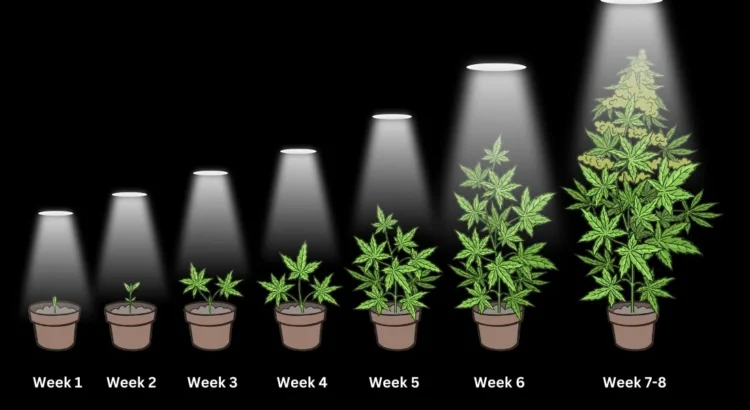
Why does home growing differ?
Compact spaces, inconsistent light control, and narrow error margins define most home cultivation environments. Unlike commercial operations built around dedicated infrastructure, home grows rely on whatever space is available. A spare room, a tent, occasionally a cupboard. Every variety decision carries more consequences when the entire operation fits within four walls.
Selecting cannabis seeds for sale in autoflowering form addresses several of those constraints directly. Age-based flowering removes precise light schedule dependency, compressed timelines allow faster turnaround within limited seasonal windows, and compact structure suits environments where neither vertical nor horizontal space can expand on demand.
That alignment between autoflowering characteristics and home growing conditions is worth examining closely. Each trait solves a specific problem home cultivators encounter regularly, and understanding which problem each trait addresses changes how growers evaluate variety options before committing.
Why does cycle length matter indoors?
Every additional week a crop runs indoors costs something. Electricity, environmental control, and time accumulate across extended cycles in ways that feel abstract until the second or third run. Photoperiod varieties hand growers control over vegetative duration, but longer cycles mean longer resource commitment, and any light schedule disruption during flowering can push the entire crop back by weeks.
Eight to eleven weeks cover seed to harvest across most autoflowering varieties. No vegetative phase extension, no mid-cycle light adjustment, no sensitivity to accidental interruption during dark periods. Running a single tent or small dedicated space becomes considerably easier when the timeline stays fixed rather than shifting based on decisions made weeks into an active crop.
Predictability changes planning. Growers who know exactly when a cycle ends can prepare the next run in advance, stagger batches, and manage resource consumption accurately.
4 reasons autoflowers suit home grows
- Compact structure – Smaller frames suit tents, cupboards, and rooms where ceiling height and floor space cannot be adjusted around plant development.
- Fixed timeline – Eight to eleven weeks from germination allows accurate resource planning without accounting for variable vegetative duration.
- Schedule independence – Flowering continues without strict dark period enforcement, reducing disruption risk in shared or makeshift growing spaces.
- Successive harvests – Faster turnaround makes back-to-back cycles within the same calendar year achievable, where photoperiod cultivation in equivalent spaces allows only one.
Practical advantages in limited spaces
- Managing restricted environments
Small spaces amplify problems that larger operations absorb easily. A plant exceeding anticipated height in a confined area creates canopy issues that are difficult to correct once the crop is mid-cycle. Autoflowering varieties develop within a predictable size range, making space planning before germination reliable rather than approximate.
- Vertical growth stays within manageable limits across most varieties without requiring aggressive training intervention.
- Compact frames allow multiple plants in areas where a single photoperiod plant would consume available space entirely.
- Reduced equipment demands
Timer-controlled lighting with precise schedule switching is essential for photoperiod flowering indoors. Equipment failure during a dark period introduces real flowering risk. Autoflowering cultivation reduces that dependency considerably.
- Minor equipment irregularities during light cycles do not interrupt flowering progression.
- Simpler light management lowers the technical threshold for growers earlier in their cultivation experience.
Autoflowering genetics suit home cultivation because the traits built into them address the constraints that limited spaces consistently produce. Compact structure, predictable cycle length, and reduced schedule dependency change what is manageable without altering what actually drives harvest quality.